Authorized use only. Synapse is for authorized security testing. Every scan is gated by an engagement scope and authorization window, server-side.
Open source, Apache-2.0
Verify Everything. Trust Nothing.
A governed control plane for software composition analysis, recon, evidence, and reporting. Deterministic where it counts, bounded where it helps, provable end to end.
Run the security lifecycle behind one governed control plane
Synapse turns a fragmented, manual security process into one controlled, auditable workflow across both point-in-time analysis (SCA, SAST, code quality, IaC) and runtime analysis (a distributed agent fleet, eBPF detections, response actions), over container and VM estates — with a single asset model, one authorization model, one hash-chained evidence chain, and one prioritized queue. Scanning, matching, license classification, scoring, and reporting are pure, reproducible Go with nothing else in the path. Where automated analysis is offered it stays strictly bounded: a proposal is only ever proposed, a typed Go state machine validates and executes, and a human approves anything intrusive.
Everything a consultancy needs to scan, prove, and report
Built as clean-architecture Go with a strict dependency rule. Every capability sits behind a port, so tools, storage, and providers are swappable.
SBOM generation
Fifteen-plus ecosystems (npm, PyPI, Maven, Gradle, Go, Cargo, RubyGems, Composer, NuGet, Hex, Dart and more) with owned per-ecosystem lockfile parsers and a pluggable producer.
Multi-source detection
A live advisory API and an offline database, cross-correlated and de-duplicated, plus an owned advisory store that ingests OSV, GHSA and CSAF feeds for detection independence.
Risk-based priority
Findings are ordered by exploitability (known-exploited catalog, then exploit-prediction score, then CVSS), never by raw CVSS alone.
License compliance
Declared-license resolution, SPDX expression parsing (AND, OR, WITH), a curated category and risk model, and coordinate recovery for shaded or metadata-less JARs.
Reachability
A deterministic call-graph engine decides whether a vulnerable symbol is actually reachable from application code, so a finding on unused code can be de-prioritized.
First-party SAST
A line-level pattern scanner for dangerous idioms across many languages, pinned to a labelled precision/recall corpus. Interprocedural and cross-file dataflow is the separate taint and call-graph reachability engine. Third-party results enter the same governed path via SARIF ingest.
Offensive testing
Recon, an attack-path graph, chained exploitation rehearsed under a governed chain of custody, adversary emulation, and authenticated DAST — all governed by a written offensive policy and a kill switch.
Runtime defense
A distributed agent fleet with eBPF detections sealed as hash-chained evidence, a telemetry tier, governed response actions, and purple-team coverage measured from emulation vs what actually fired.
Cloud posture (CSPM)
Read-only AWS, Azure and GCP connectors behind a sandboxed helper with vault-ref credentials and per-operation server-side authorization, plus IaC-vs-live drift findings.
Tamper-evident evidence
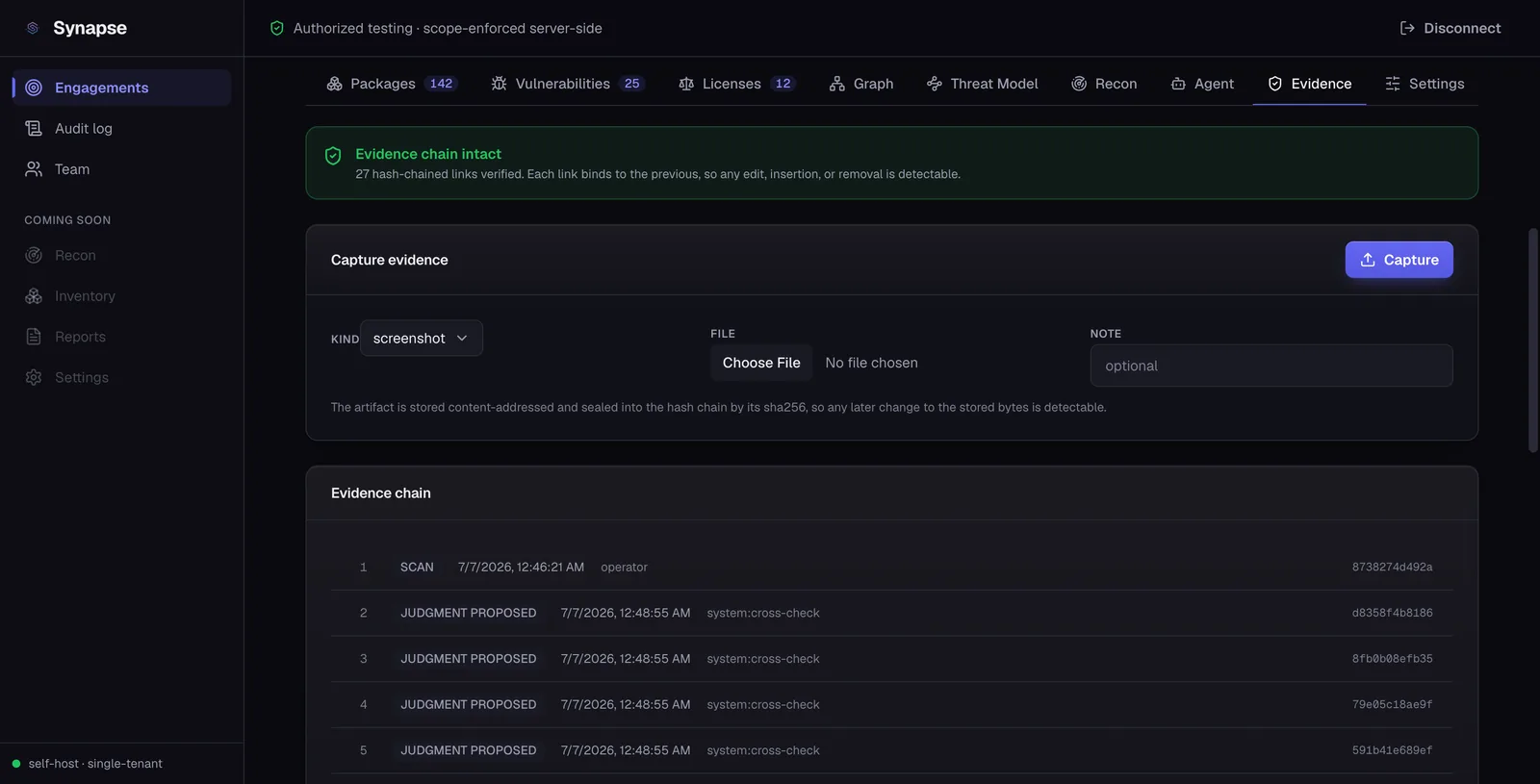
Every artifact is hash-chained. A broken chain blocks the report. Audit and evidence logs are append-only and can be anchored with an RFC-3161 timestamp.
Hardened execution
Heavy tools are shelled out via argv arrays, never a shell string, inside a Linux sandbox with egress scoping. Scope and the authorization window are enforced before any tool runs.
RBAC and tenancy
Per-action role-based access control and tenant isolation flow through a single authorization chokepoint. Secrets stay server-side in a credential vault.
Standards native
Exports CycloneDX and SPDX with PURL, SARIF and OpenVEX; ingests CSAF and OVAL advisory feeds; prioritizes with KEV and EPSS. Import a client SBOM as the scan inventory, export the results in the format they expect.
Bounded AI analysis
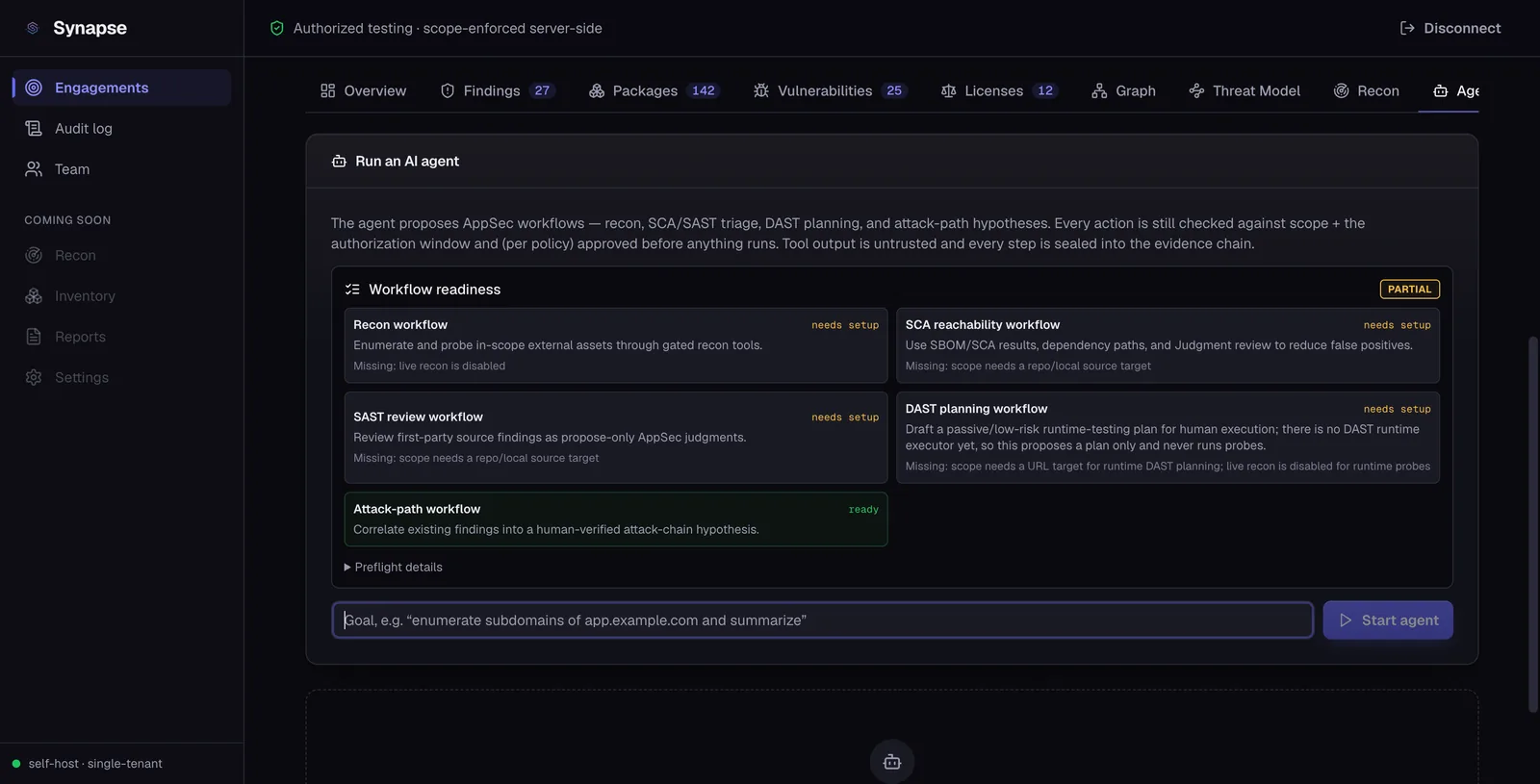
An optional analysis layer proposes reachability, critique, threat and write-up drafts. Every claim goes through propose, verify, confirm, gated by a distinct verifier or a human. No model ever sits in the report path.
Product tour
A dark-mode-first workspace built for evidence
Every screen below is the current build. Tables virtualize past fifty rows, and loading, empty and error states are handled throughout.
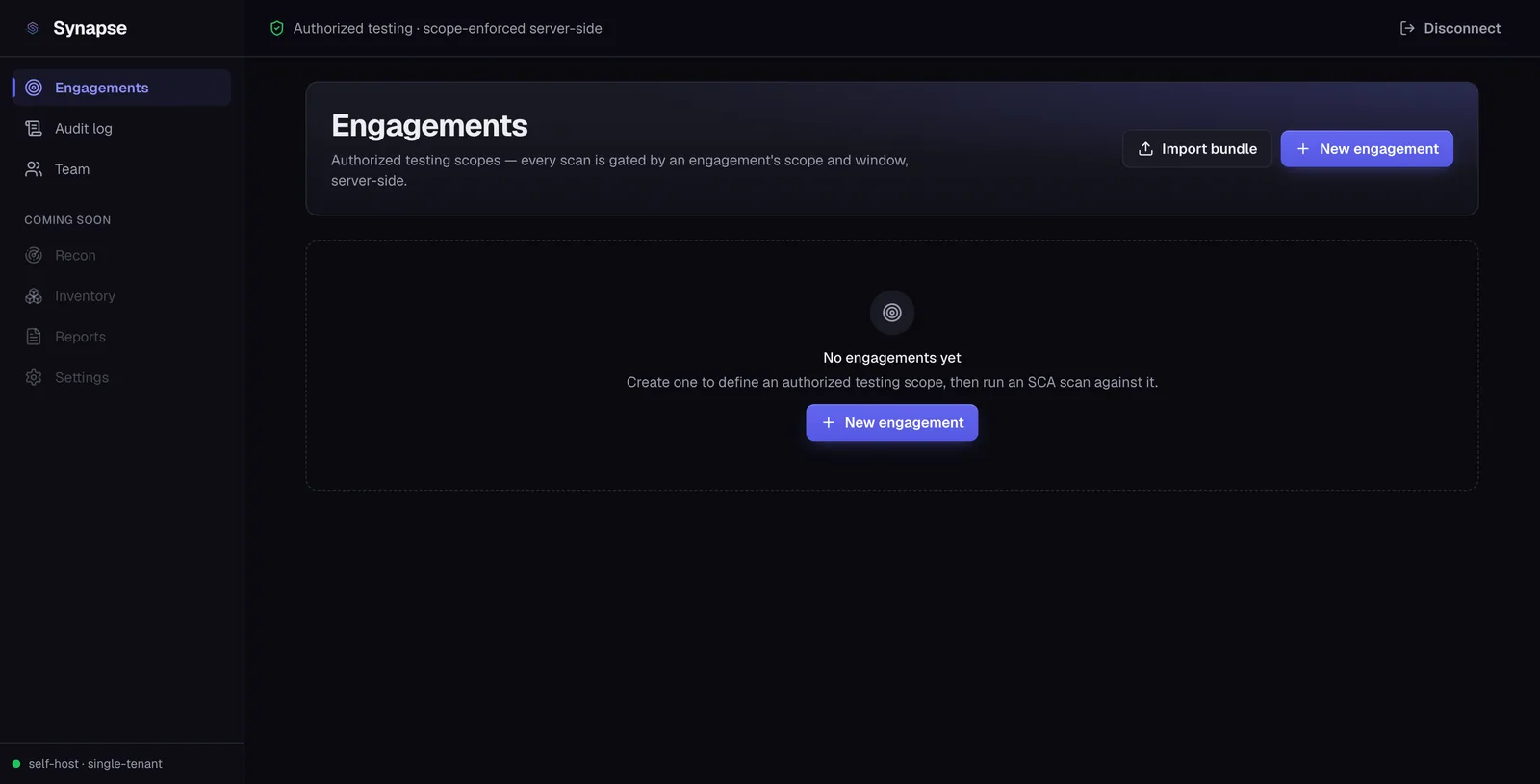
localhost:5173 / engagements
Engagements overview: every scan is gated by a scope and an authorization window, enforced server-side.
01 Onboarding and access
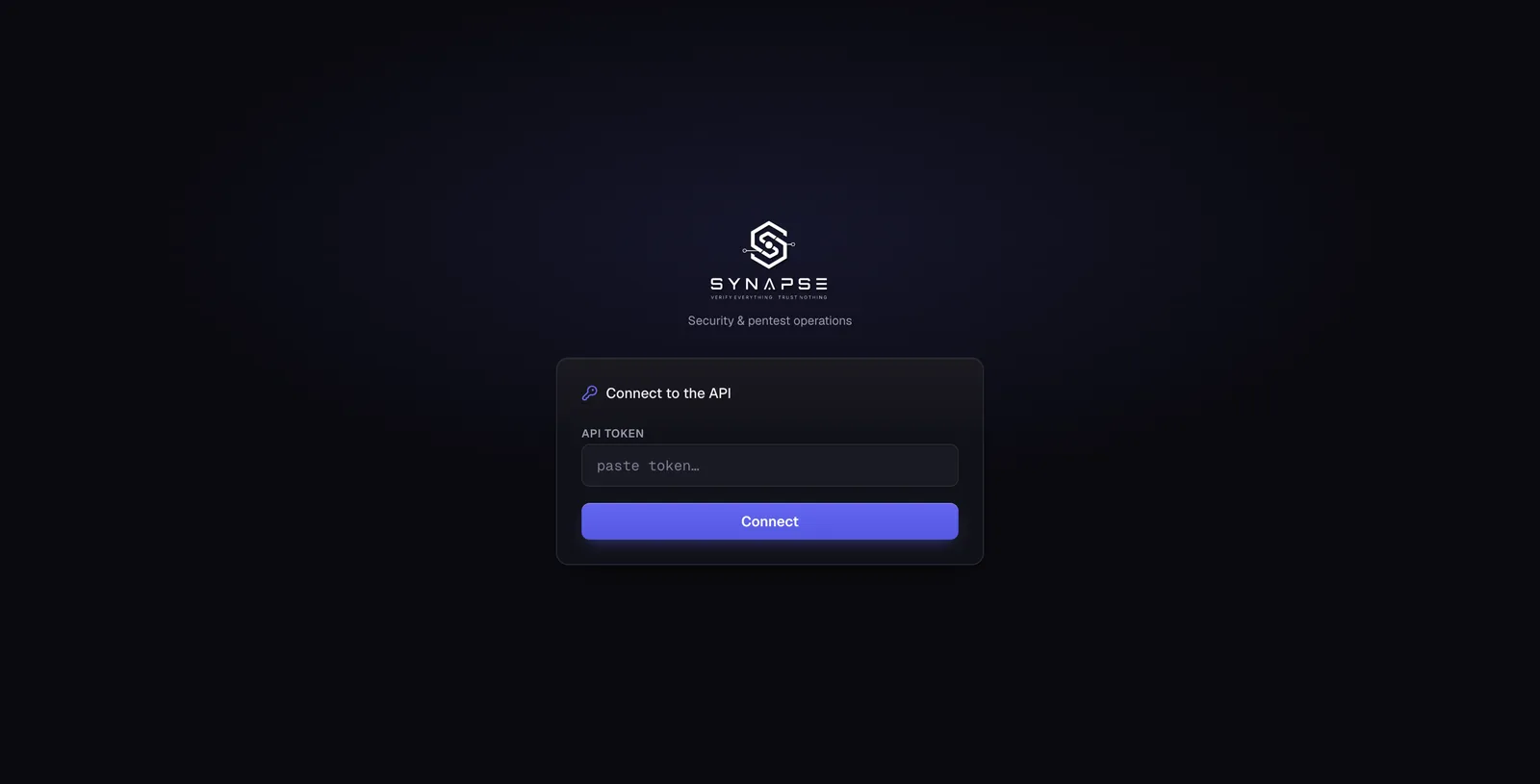
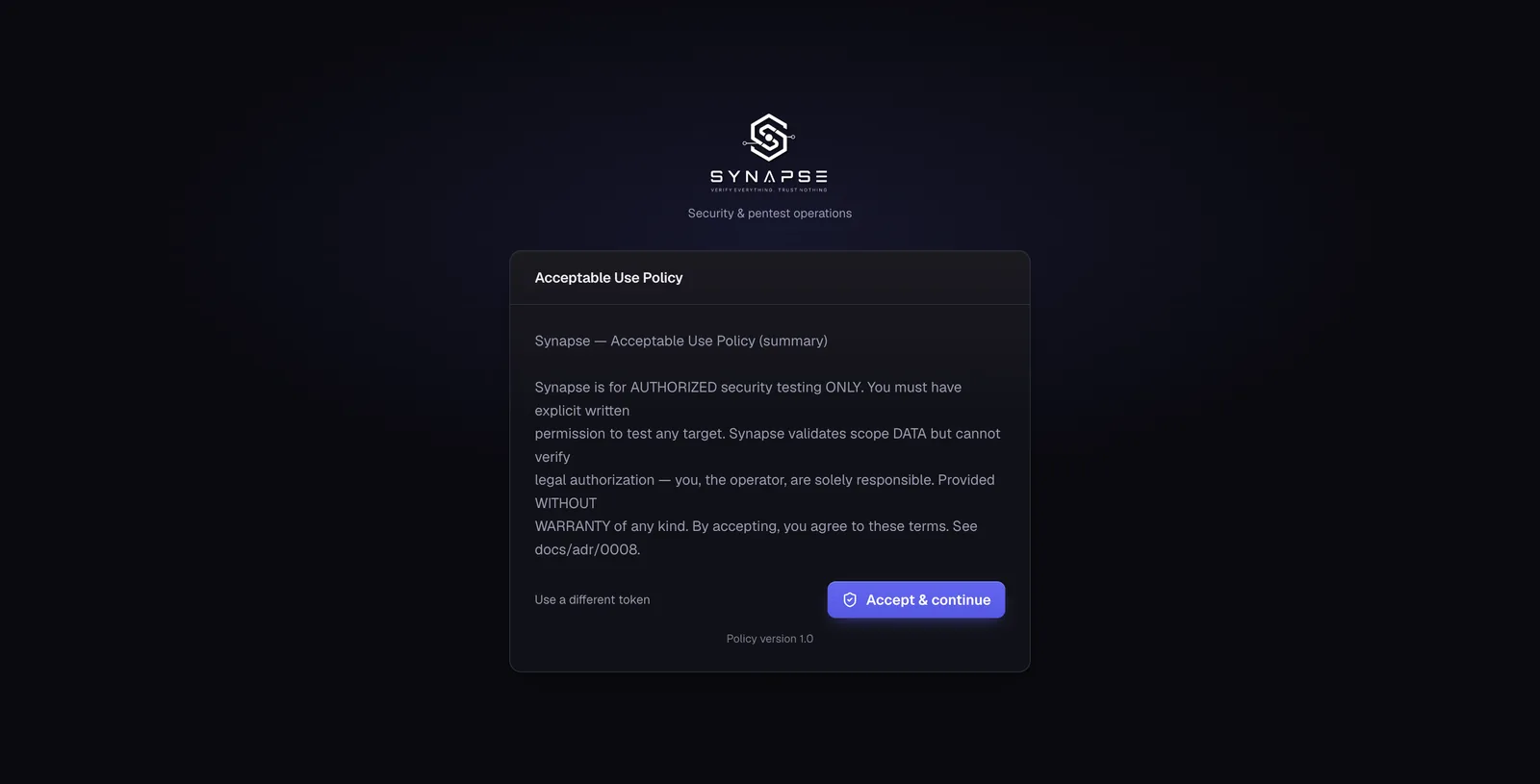
Token login with no anonymous access, and a first-run Acceptable Use Policy gate the operator must accept.
/login
/aup
02 Create and drive an engagement
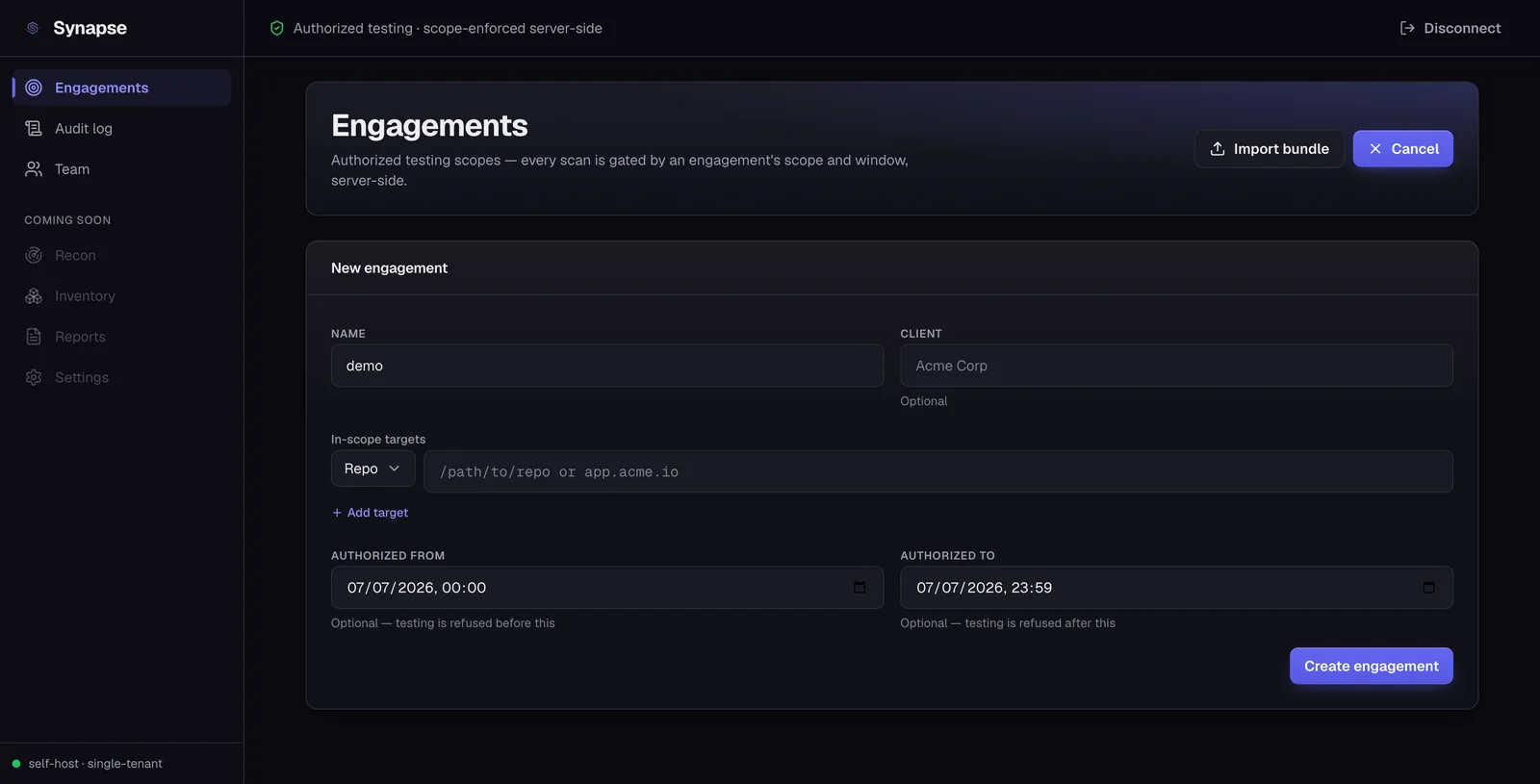
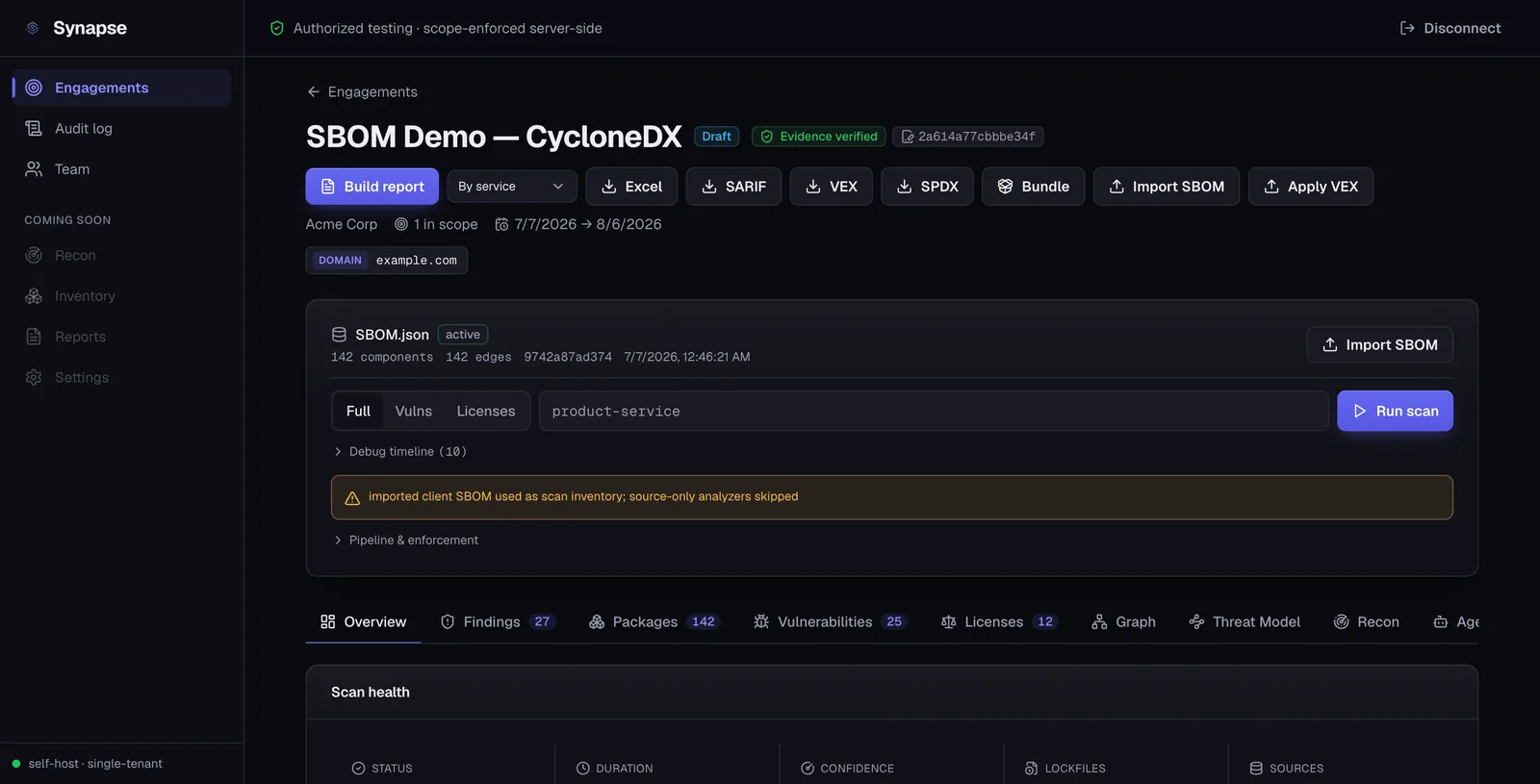
Define an authorized scope and window, then work the engagement: inventory, findings, evidence, and reports in one place.
new engagement
engagement detail
03 Vulnerabilities and findings
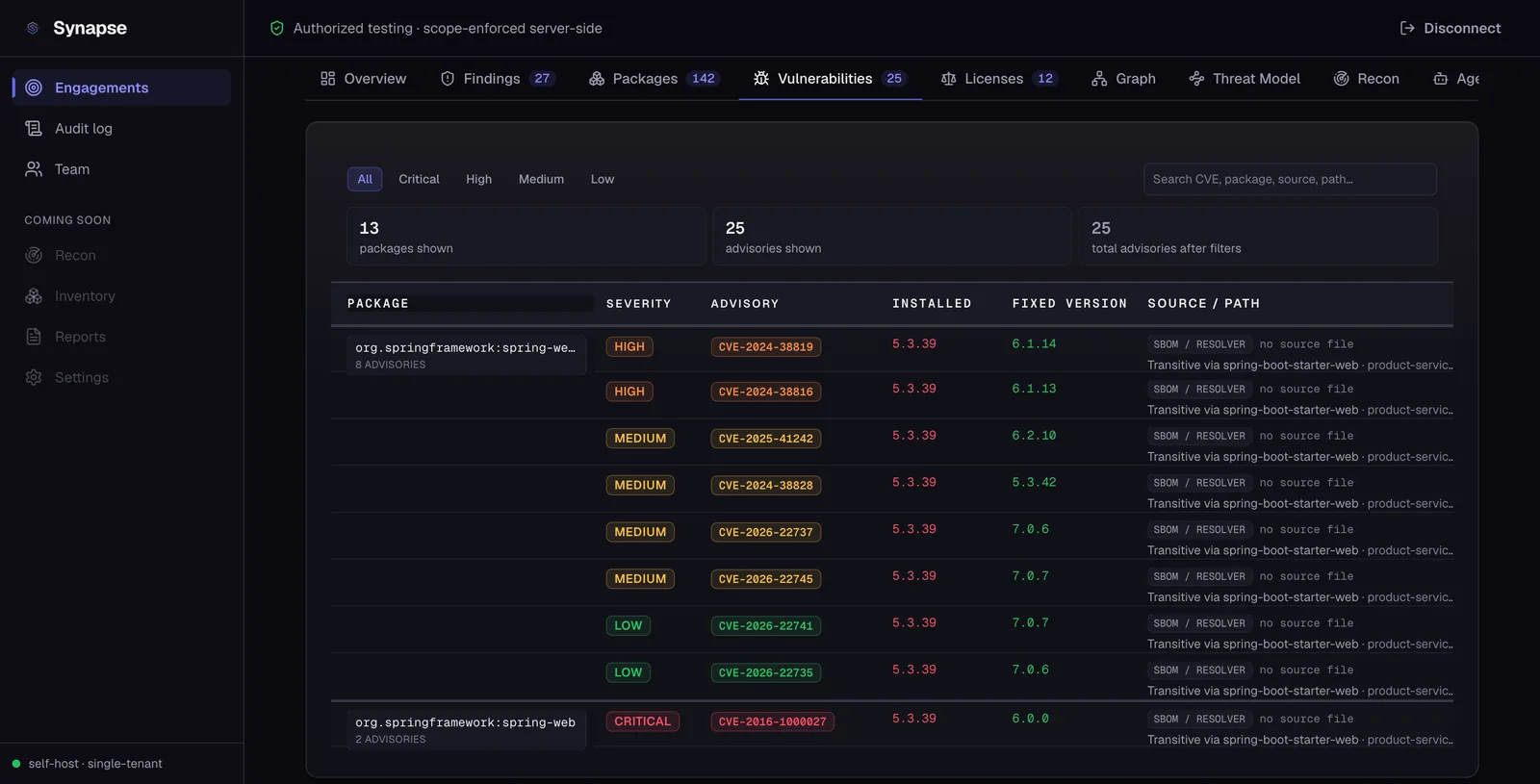
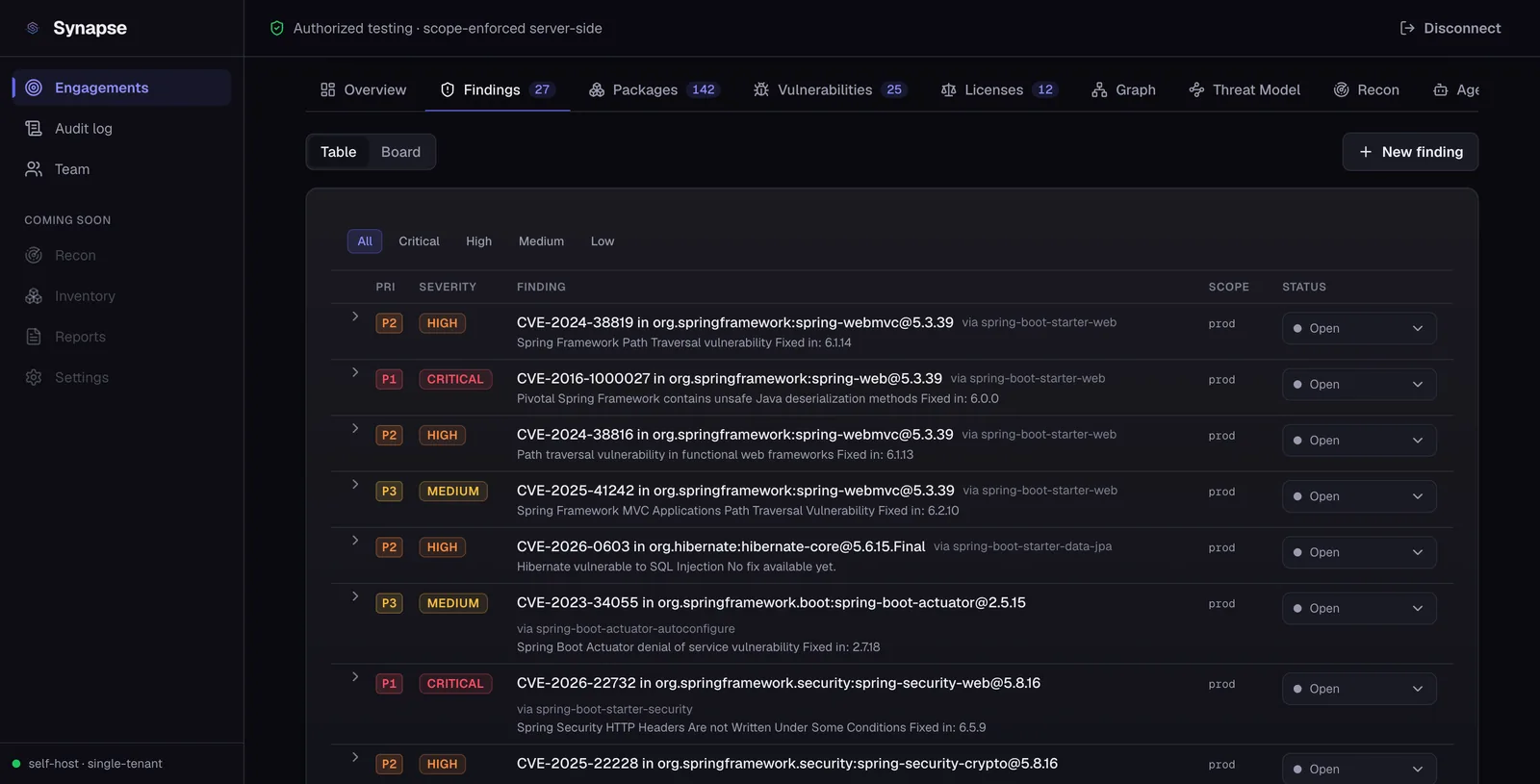
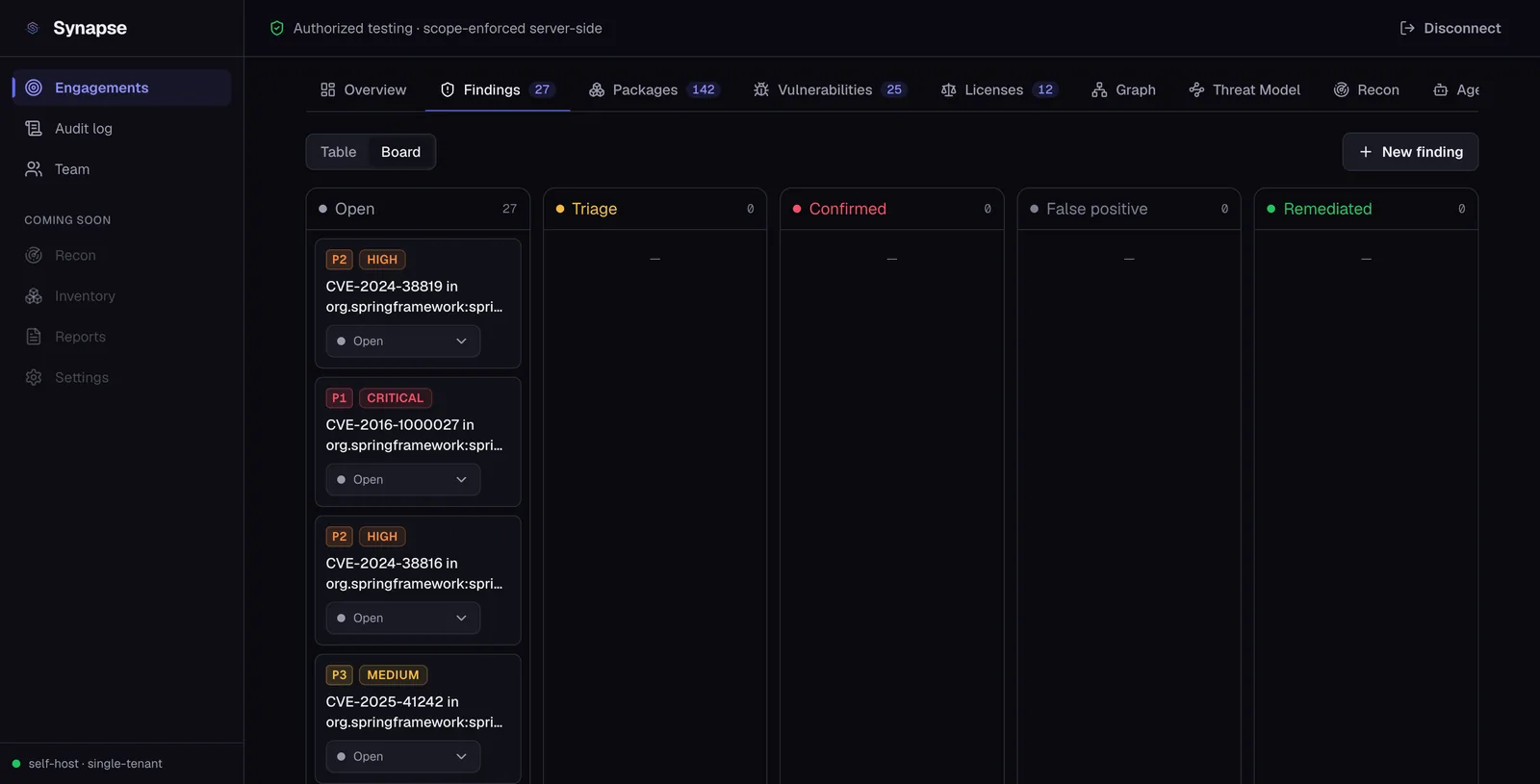
Vulnerabilities ranked by real risk, promoted into findings you can triage as a table or a board.
vulnerabilities
findings table
findings board
04 SBOM, licenses and the dependency graph
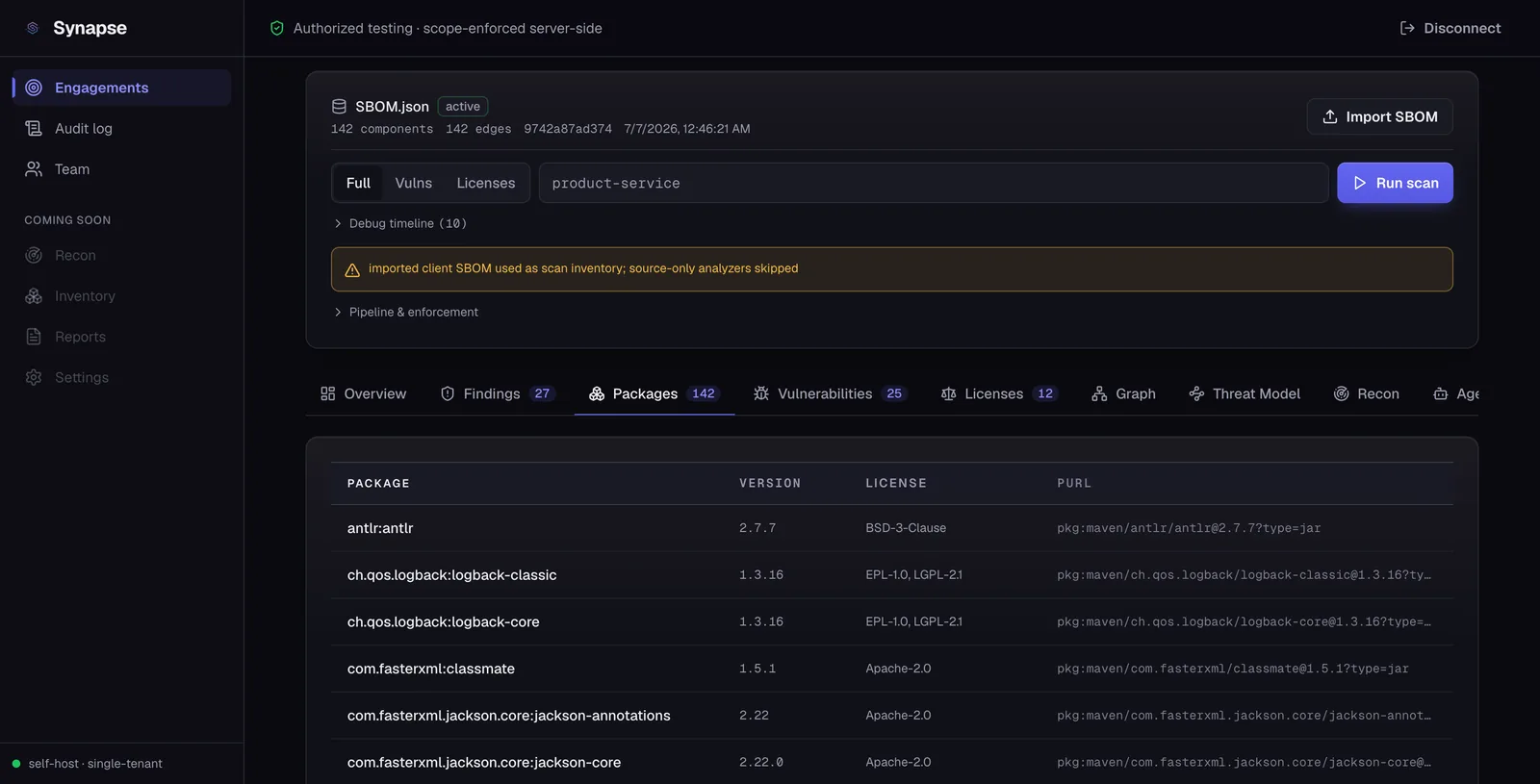
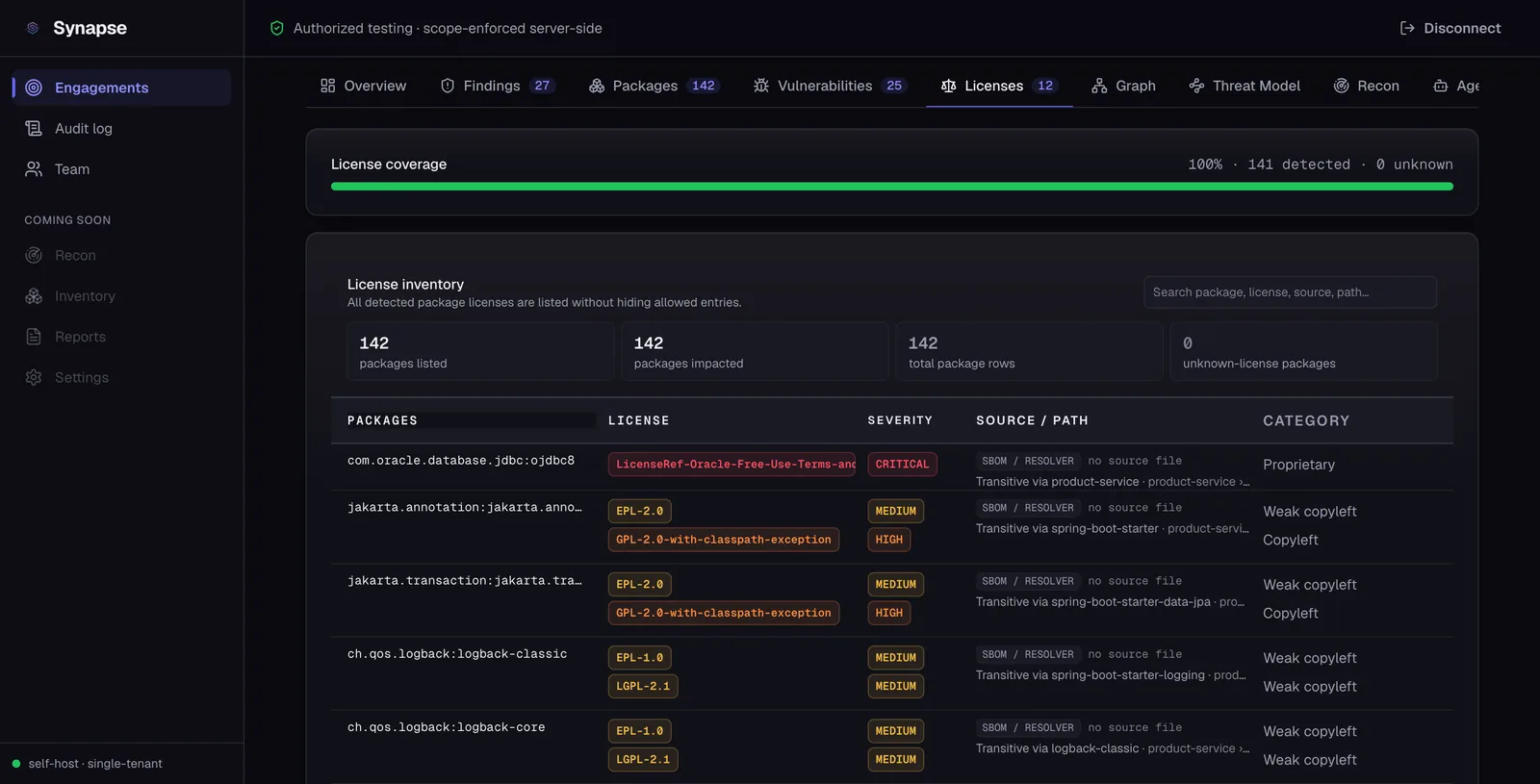
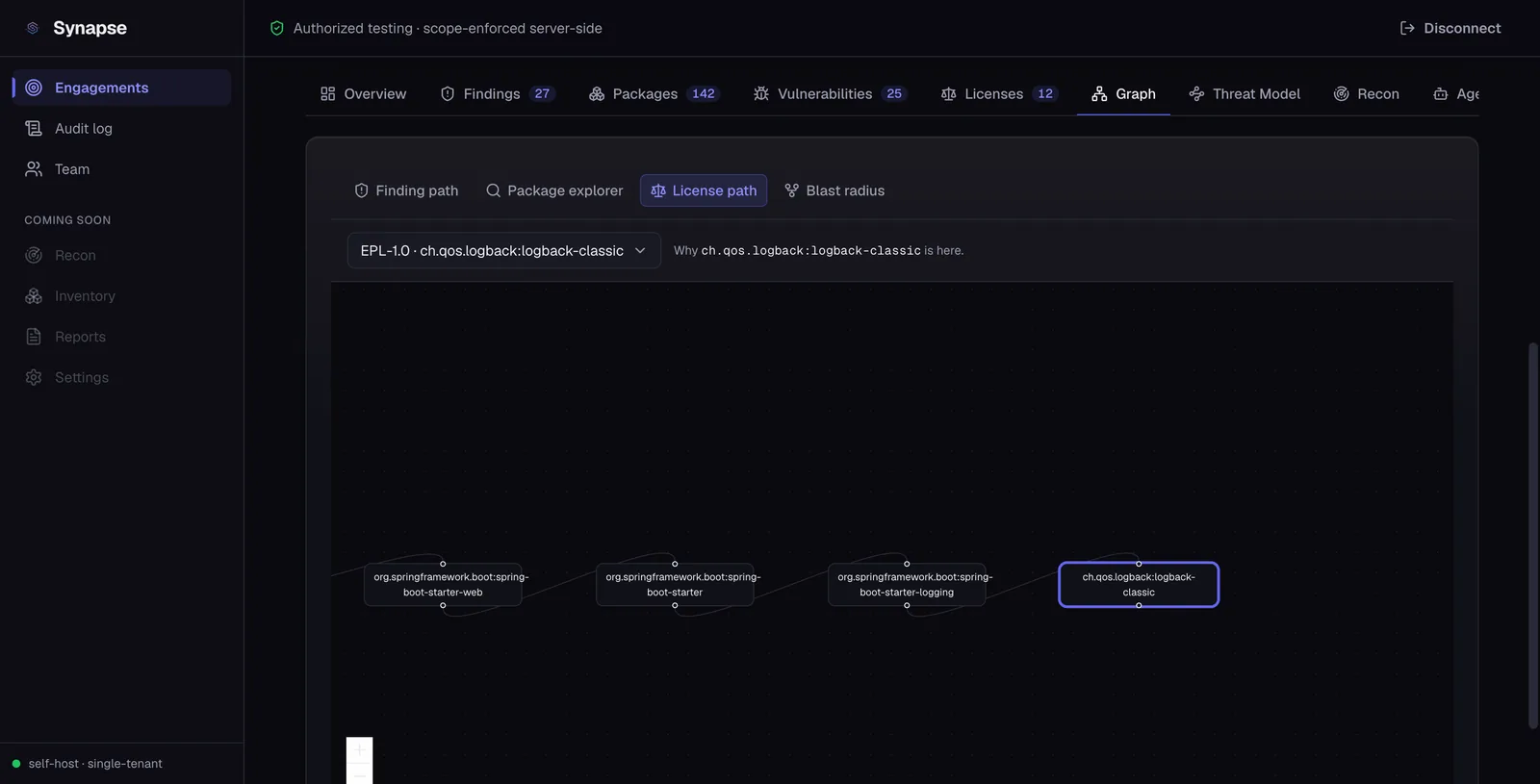
The full component inventory, license posture with SPDX categories, and the resolved dependency graph.
packages
licenses
dependency graph
05 AI analysis, evidence and audit
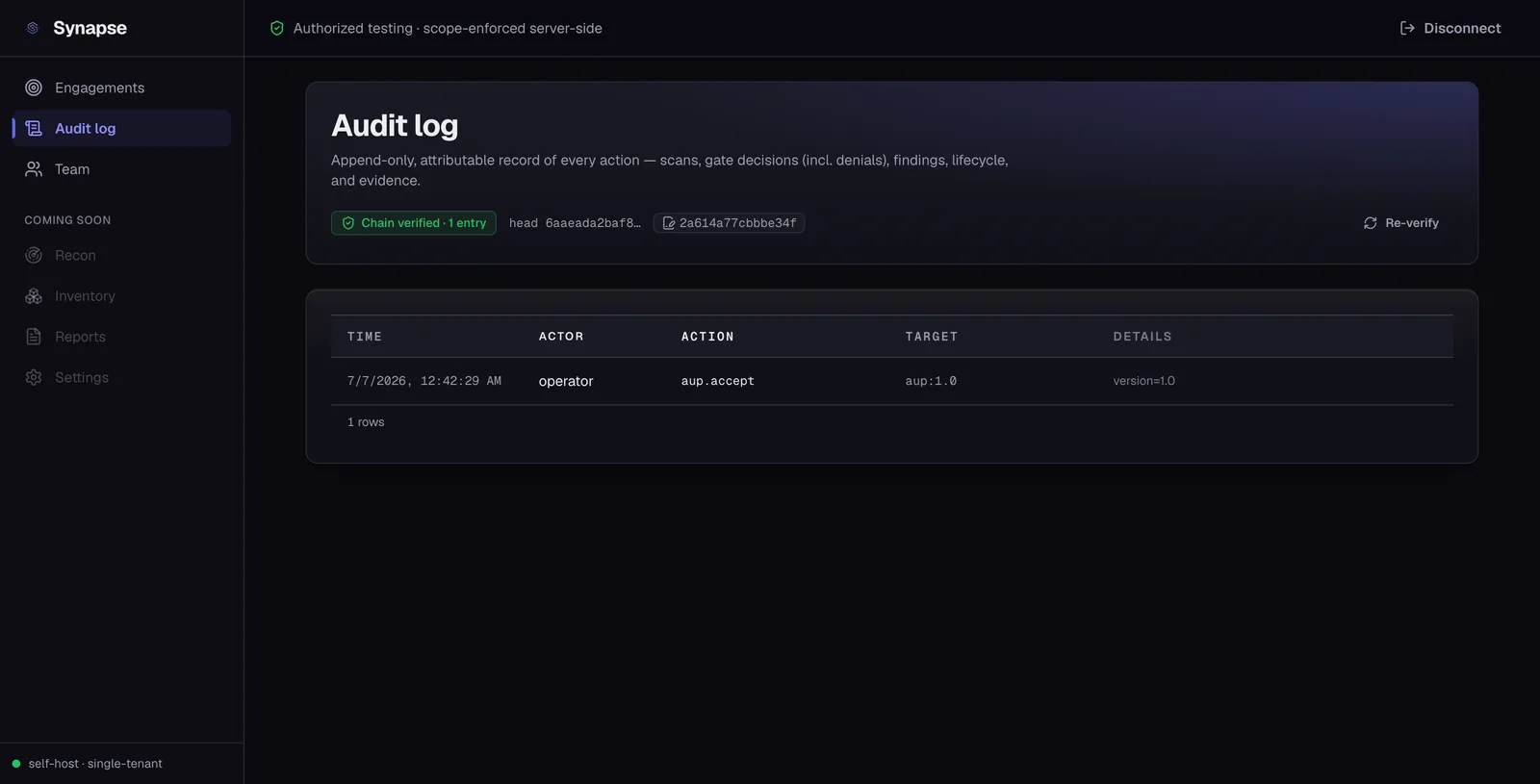
The bounded agent proposes, a human approves. Evidence is hash-chained, and every action lands in an append-only audit log.
AI agent
evidence chain
audit log
06 Team and settings
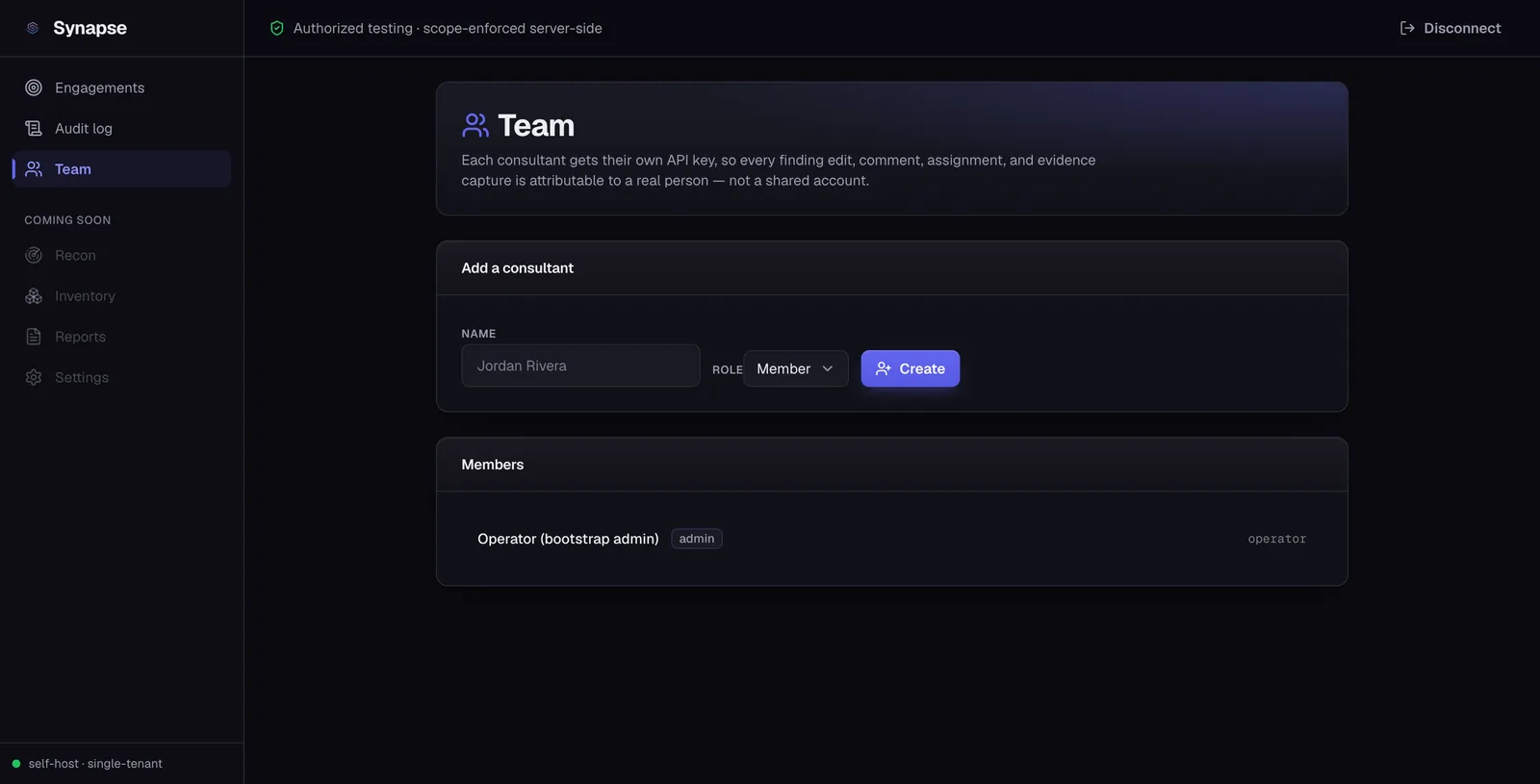
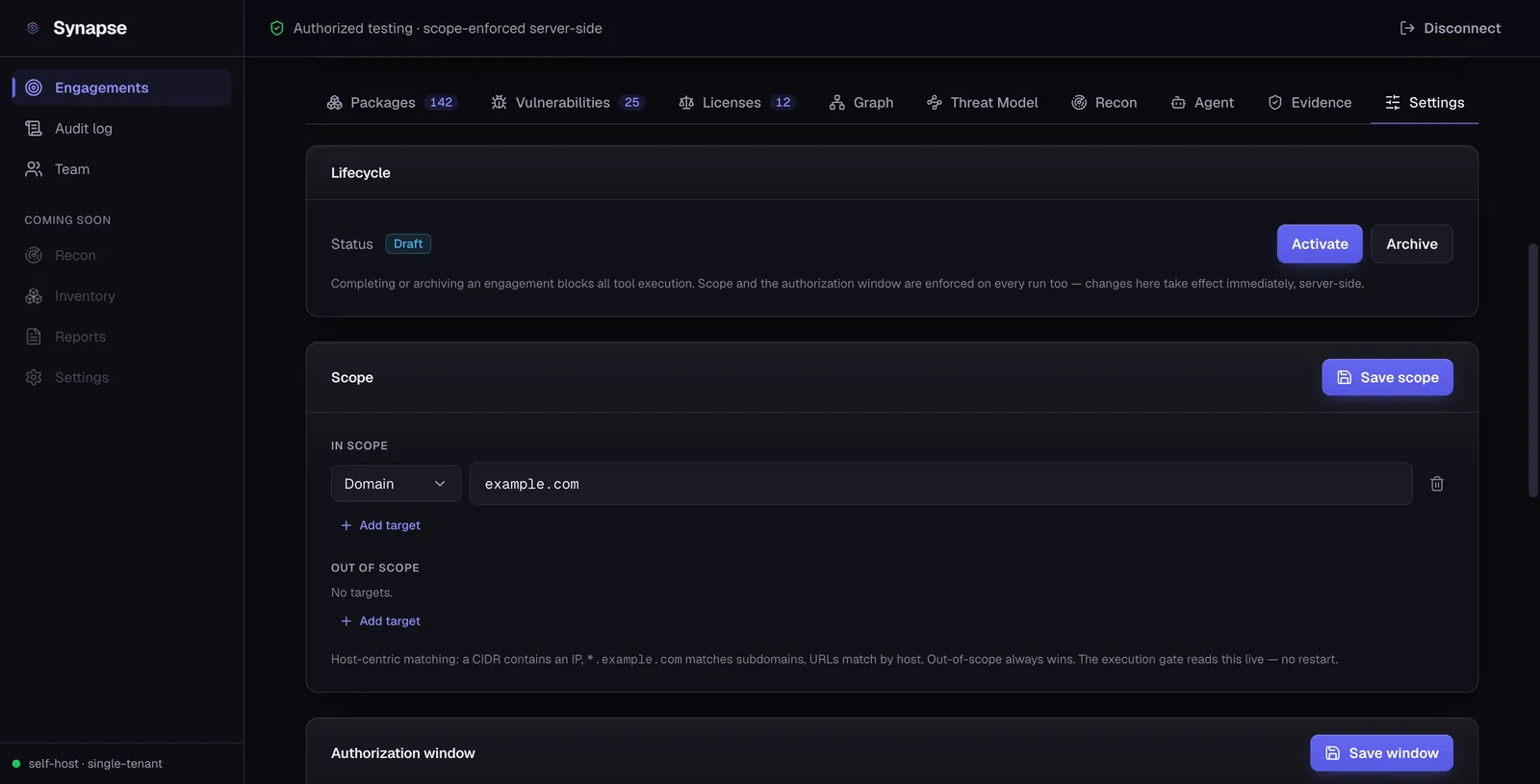
Role-based team management and per-engagement settings.
team
settings
Requirements
What you need to run it
The API, SCA, findings and reports run on any OS for development. The hardened sandbox, live recon and egress scoping need a Linux host.
Go 1.26
Pinned in go.mod. Builds cgo-free, so the container image is distroless.
Node and pnpm
For the web dashboard. Use pnpm, not npm or yarn.
Syft and Grype
Optional. The owned SBOM producer + advisory store are the default and need no external tool; Syft (broader SBOM coverage / cross-check) and Grype (offline database) are supported extras. make tools installs both, pinned and checksum-verified.
PostgreSQL and S3 (optional)
For durable persistence and evidence artifacts. A blank DSN runs an in-memory dev store.
Docker (optional)
The easiest way to run the full stack, and the simplest path to a complete run on any OS.
Linux host (for the sandbox)
bubblewrap, seccomp, cgroups and network namespaces. Without them, sandboxed execution fails closed rather than running unsandboxed.
Install and setup
From clone to a running dashboard
Pick the path that fits: run the full stack with Docker, or build and run it natively.
Clone the repository
Grab the source and change into it.
Install dependencies and tools
make install pulls Go modules and web deps. make tools installs Syft and Grype into ./bin.
Set the one required variable
SYNAPSE_API_TOKEN is mandatory. The server refuses to start without it. There is no anonymous access.
Run the API and dashboard
make dev starts the API on :8080 and the dashboard on :5173. Open the dashboard, paste the token, accept the AUP.
Docker, full stack
# Postgres, object store, API (syft + grype bundled), dashboard
docker compose -f deploy/docker-compose.full.yml up --build
# then openopen http://localhost:5173
Native, development
make install
make tools
export PATH="$PWD/bin:$PATH"export SYNAPSE_API_TOKEN="$(openssl rand -hex 32)"# blank DB DSN runs an in-memory dev storemake dev
Migrations are embedded in the binary and applied automatically at startup. There is no separate migrate step. A blank SYNAPSE_DB_DSN runs fully in memory, so nothing is persisted.
Configuration
Everything is an environment variable
Synapse reads the process environment directly. Copy .env.example and adjust. Empty means unset, so the built-in default applies. Booleans accept 1/0/true/false, durations use Go syntax (30s, 10m, 1h).
Required Server exits without it
Variable
Default
What it does
SYNAPSE_API_TOKEN
(none)
Bootstrap-admin bearer token. The API exits if empty. Generate with openssl rand -hex 32.
Core and server
Variable
Default
What it does
SYNAPSE_HTTP_ADDR
:8080
Listen address.
SYNAPSE_ENV
development
Non-prod values: development, dev, local, test, ci. Any other value is treated as production and turns on the strict, fail-closed gates.
SYNAPSE_LOG_LEVEL
info
Log verbosity.
SYNAPSE_AUP_VERSION
1.0
Acceptable Use Policy version the operator must accept on first run.
Persistence and storage
Variable
Default
What it does
SYNAPSE_DB_DSN
(in-memory)
PostgreSQL connection URL. Empty runs an in-memory dev store, so nothing is durable.
SYNAPSE_BLOB_ENDPOINT
(in-memory)
S3 or MinIO endpoint as host:port. Empty runs an in-memory blob store. Pairs with SYNAPSE_BLOB_ACCESS_KEY, SYNAPSE_BLOB_SECRET_KEY, SYNAPSE_BLOB_BUCKET.
Custody and signing Required in production
Variable
Default
What it does
SYNAPSE_VAULT_MASTER_KEY
(ephemeral)
AES-256 credential-vault master key. Empty uses an ephemeral dev key, so stored secrets do not survive a restart. Never logged.
SYNAPSE_EVIDENCE_SIGNING_SEED
(ephemeral)
ed25519 seed attesting evidence and audit chain heads. Never logged.
SYNAPSE_TSA_URL
(none)
RFC-3161 timestamp authority for external anchoring. Empty leaves the chain signed but not anchored, still tamper-evident.
Software composition analysis
Variable
Default
What it does
SYNAPSE_SBOM_PRODUCER
syft
syft (pinned binary, full coverage, dep-graph edges) or ownsbom (detection-independent owned parsers, components only).
SYNAPSE_GRYPE_DB_DIR
(online)
Pin Grype's vuln database to a pre-synced directory for offline, reproducible scans.
SYNAPSE_FINDING_MIN_SEVERITY
info
Lowest severity promoted to a finding: critical, high, medium, low, info. Default promotes everything; set high to tighten the floor.
SYNAPSE_SCAN_TIMEOUT
10m
Per-scan timeout. 0 disables.
SYNAPSE_OWNED_ADVISORY
false
Match the SBOM against the owned advisory store, alongside the live and offline sources. Populate it first with synapse-cli sync-advisories.
SYNAPSE_JARHASH_ONLINE_ENABLED
false
Recover the coordinate of a shaded or metadata-less JAR by its SHA-1, so its vulnerabilities are attributed.
Recon and execution sandbox Sandbox required in production
Variable
Default
What it does
SYNAPSE_SANDBOX_ENABLED
false
Run tool execution inside the bubblewrap sandbox. If set but bubblewrap is missing, startup fails closed and never runs unsandboxed.
SYNAPSE_TOOL_HASHES
(TOFU)
Authoritative sha256 pins. The sandbox refuses a binary whose hash does not match.
SYNAPSE_RECON_VIA_WORKER
false
Route recon through the durable queue to synapse-worker. Requires PostgreSQL.
AI agent orchestration Off by default
Variable
Default
What it does
SYNAPSE_AGENT_ENABLED
false
Turn on the agent orchestrator.
SYNAPSE_LLM_BASE_URL
(none)
OpenAI-compatible Chat Completions endpoint. Pairs with SYNAPSE_LLM_API_KEY (never logged) and SYNAPSE_LLM_MODEL (required when the agent is enabled).
SYNAPSE_AGENT_APPROVAL_MODE
manual
Human-in-the-loop approval: manual (a human approves every action), filter, or auto.
SYNAPSE_AGENT_MAX_STEPS
16
Per-run bound on agent steps. See also token budget and max duration.
AI analysis brain Opt-in, best-effort
Variable
Default
What it does
SYNAPSE_JUDGMENTS_ENABLED
false
Judgment lifecycle routes (verify, accept, list). Prerequisite for the analyzers below.
SYNAPSE_SAST_ENABLED
false
Pattern SAST in the scan pipeline: weak crypto, hardcoded secrets, insecure config.
SYNAPSE_REACHABILITY_ENABLED
false
Call-graph reachability proof. A deterministic proof overrides an LLM opinion.
Agent proposes finding write-up prose. A distinct human signs off.
This is the working set. The full reference, including connection-pool sizing, recon bounds, MCP server variables and feed overrides, lives in .env.example with an inline note on every option.
Command line
Gate your CI on real risk
synapse-cli runs the same pipeline as the server. It creates an ephemeral, scope-checked engagement, so scope enforcement is exercised, not bypassed. Nothing is persisted.
Scan a project, fail the build
# exit non-zero on any high-or-critical vuln
./bin/synapse-cli scan . --fail-on high

# licenses only
./bin/synapse-cli scan . --mode licenses

# scan a container image, offline
./bin/synapse-cli scan alpine:3.19 --image --offline
GitHub Actions
- name: SCA scan
  run: |
    make tools
    make build
    ./bin/synapse-cli scan . --fail-on high
Exit code is 0 when no finding meets the threshold, non-zero otherwise. Wire it straight into a pipeline step.
Architecture
Clean architecture, dependencies point inward
All external I/O (database, tools, storage, sandbox) goes through ports, which are interfaces in the usecase layer. The composition root wires them in main, with no business logic.
domain←usecase←adapter / infrastructure
Binary
Role
synapse-api
HTTP API server, the primary service.
synapse-cli
Run an SCA scan from the command line, CI-friendly.
synapse-worker
Durable job runner for recon and background jobs, lease-based.
synapse-callgraph
Sandboxed call-graph builder for reachability analysis.
synapse-mcp
Read-only, propose-only integration server. Never executes.
Layer
May import
internal/domain
Only domain and the standard library.
internal/usecase
domain and the ports it defines.
internal/adapter
usecase and domain.
internal/infrastructure
Implements the ports (DB, tools, storage).
internal/platform
Cross-cutting helpers (config, ids, logging).
The team
Built by the founding team and contributors
The founders and lead maintainer who steer Synapse, the engineers and designer who shaped the platform and its brand, and the AI-engineer contributors extending it.